Christianity and the Challenge to Deep-Rooted Traditions
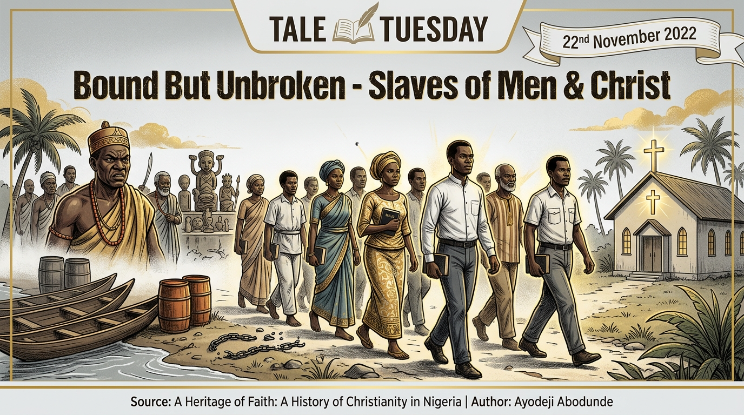
The Christian faith made progress on several fronts in the Niger Delta area. It challenged and subdued evil traditions. However, when Christianity touched an area that was most dear to tradition – the keeping of domestic slaves – there was a revolt. The keeping of domestic slaves formed an integral part of the societal structure of many of the Delta communities. People could sacrifice slaves to appease the gods or use them for any other inhuman activity as the situation demanded. Society attached no issue of morality to this practice because people regarded slaves simply as property.
Resistance from House Heads and Chiefs
Trouble eventually broke out in Bonny when slaves who had converted to Christianity refused to join their various houses in the worship of their gods. The house heads considered this an intolerable challenge to their authority.
To make matters worse, on Sundays, the slaves would dress up and go to church instead of pulling canoes to the palm oil market as expected. Again, some of the converted slaves put away all their wives except one. This created a social challenge because the rejected women could not remarry, since intra-house marriage was taboo.
These slaves also engaged in evangelism in the oil market as they carried out their business. All this incensed the chiefs and the heads of the various houses.
Persecution of Christian Slaves Begins
From 1872, persecution began in earnest. At first, the house heads meted out minor punishments to the Christian slaves. But things reached a peak in 1874 when one house head, Captain Hart, declared a festival in honor and worship of a deceased father of the house.
Three of the Christian slaves refused to participate. As punishment, the house heads beat or confined two of them, while they killed the third, Joshua Hart.
The account of Joshua Hart’s ordeal is touching and heroic. Four men caught him and flung him into the air so that he might fall with heavy force to the ground. They did this again and again, but Joshua still refused to abjure Christ.
READ ALSO: WILLIAM & CATHERINE BOOTH (PART 16)
Joshua Hart’s Confession of Faith
Two other chiefs came forward and tried to reason with him. They then offered him bribes and later tried to browbeat and threaten him. But it was of no avail.
In fearless words he answered: “If my master requires me to do any work for him, however hard, I will try my best to do it. If he even requires me to carry the world itself on my head, I will try, if I can, to do it. But if he requires me to partake of things sacrificed to the gods, I will never do it.”
They then left him to the tender mercy of his master. His master took the poor fellow, bound him hand and foot, into his canoe out in the river to drown him.
Martyrdom of Joshua Hart
His master flung him into the water, but he did not sink. So, he hauled him out again, shook him, and asked if he would recant. But Joshua, like his great name-sake, recalled the promise: “Be not afraid, neither dismayed, for the Lord thy God is with thee,” and refused to deny his Lord.
Once more, his master hauled his body into the river. He barbarously beat Joshua’s head with a paddle. As a finishing stroke, he thrust him through with a sharp-pointed pole.
Legacy of Faith and Triumph of Christianity
After Joshua’s death, the Bonny confirmation class then used to pray, “Give us the firmness of Joshua.”
Joshua Hart was just one of the martyrs, for many were killed in several ways for the sake of Christ at this period. In all, the slaves prevailed. By 1882, Bonny had over one thousand slaves totally committed to Jesus Christ.
Indeed, some of the arrowheads of the persecution in the Delta stations died in the Christian faith. The dying message of one of them was, “Tell the master when he comes that I die in Christ.”e arrowheads of the persecution in the Delta stations died in the Christian faith. The dying message of one of them was, “Tell the master when he comes that I die in Christ.”

Date: 22nd November 2022
Title: Bound But Unbroken – Slaves of Men & Christ
Source: A Heritage of Faith: A History of Christianity in Nigeria Pg 26-29
Author: Ayodeji Abodunde
Tale Tuesday 018
Previous post
Next post