The Church’s Journey into Legalism and Monasticism
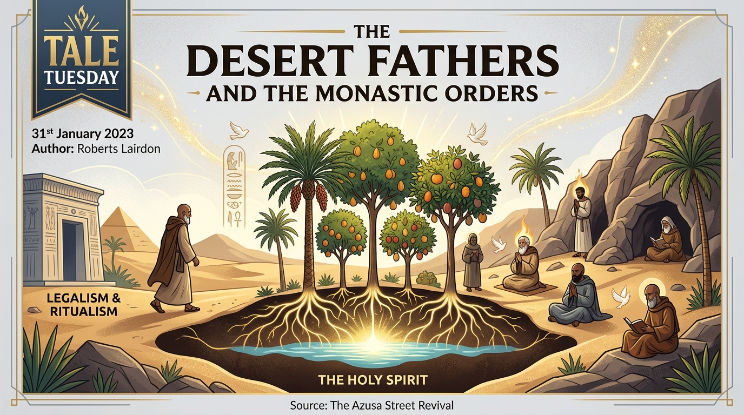
As the church sailed into an ocean of legalism and ritualism, monastic orders began to emerge. In search of a deeper spirituality, some believers turned inward and took their pursuit to the deserts and the mountains. Some forsook riches and lived among the poor, seeking the original wells of spirituality.
Christian monasticism began in the deserts of Egypt and Syria in the fourth century a.d. The Desert Fathers, as they were called, sought to experience the realities of the Kingdom of Heaven. As they retreated from organized religion, they sought to recover the simple ways of primitive Christianity.
Abba Poemen said that Abba John said that “the saints are like a group of trees, each bearing different fruit, but watered from the same source. The practices of one saint differ from those of another, but it is the same Spirit that works in all of them.”
The Saints and the Spirit’s Work
Even though the gifts of the Spirit received little recognition, pockets of Pentecostals still existed. Evidently, some “heretics” in Augustine’s day believed in receiving the Holy Spirit with evidence of speaking in tongues.
Augustine sought to refute them with the following argument:
- Tongues are valueless without love – 1 Cor 13.
- Love comes only by the Spirit – Rom 5:5.
- They did not have the Spirit because they did not belong to the Catholic Church.
- No one expected tongues any longer anyway.
READ ALSO: WILLIAM & CATHERINE BOOTH (PART 24)
Monastic Orders in the Middle Ages
Among the principal monastic orders that evolved in the Middle Ages were the Carthusians in the 11th century and the Cistercians in the 12th. The mendicant orders, or friars—Dominicans, Franciscans, and Carmelites—arose in the 13th century.
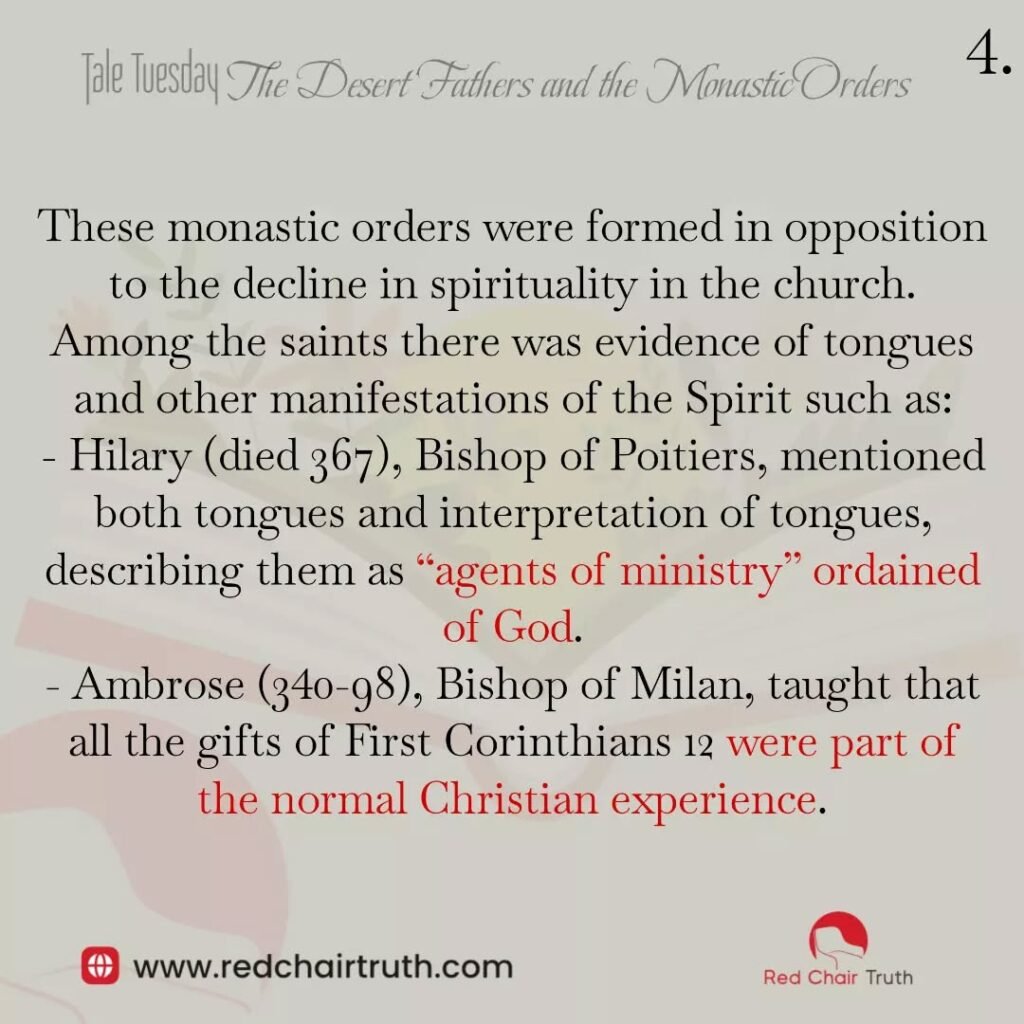
These monastic orders formed in opposition to the decline in spirituality in the church.
Evidence of Tongues and the Spirit’s Manifestations
Among the saints, there was evidence of tongues and other manifestations of the Spirit, such as:
- Hilary (died 367), Bishop of Poitiers, mentioned both tongues and interpretation of tongues. He described them as “agents of ministry” ordained of God.
- Ambrose (340-98), Bishop of Milan, taught that all the gifts of First Corinthians 12 were part of the normal Christian experience.
The Decline of Speaking in Tongues
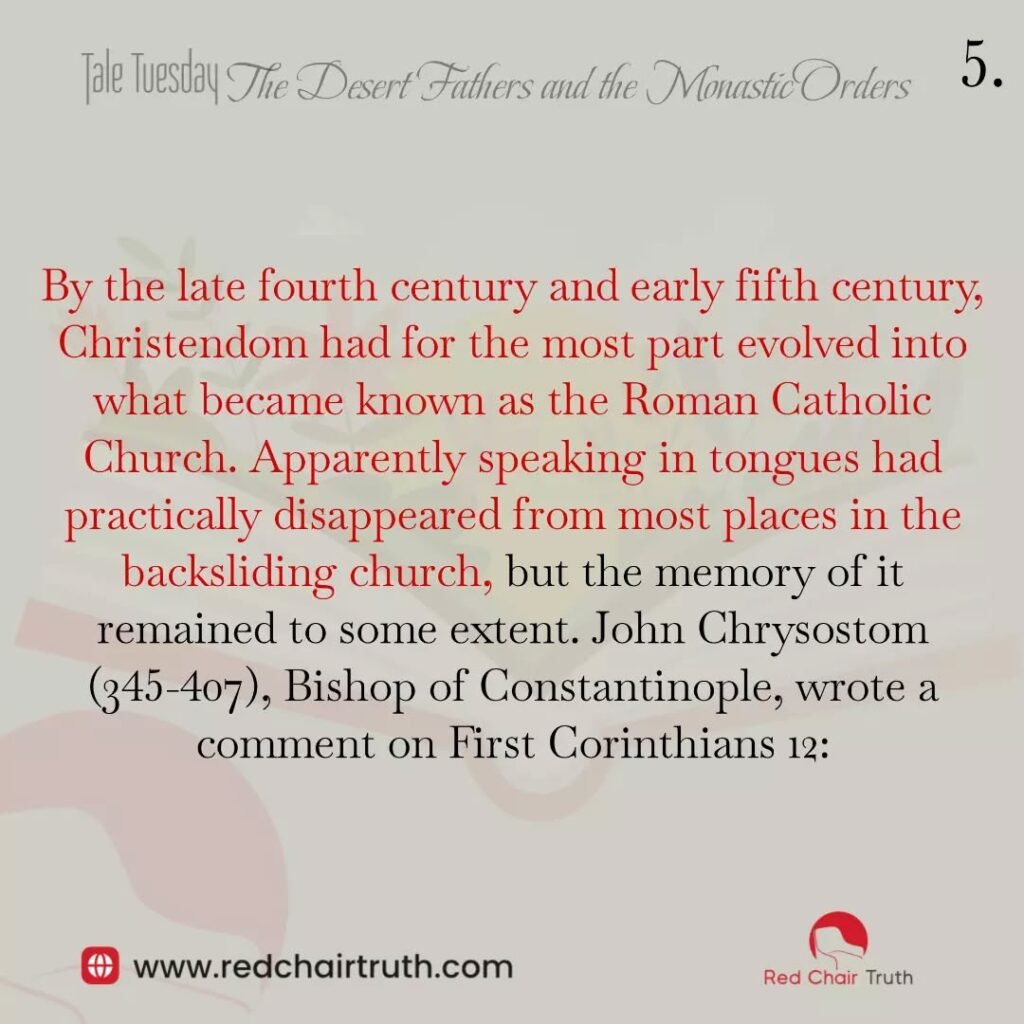
By the late fourth century and early fifth century, Christendom had, for the most part, evolved into what became known as the Roman Catholic Church. Apparently, speaking in tongues had practically disappeared from most places in the backsliding church. However, the memory of it remained to some extent.
John Chrysostom (345-407), Bishop of Constantinople, wrote a comment on First Corinthians 12:
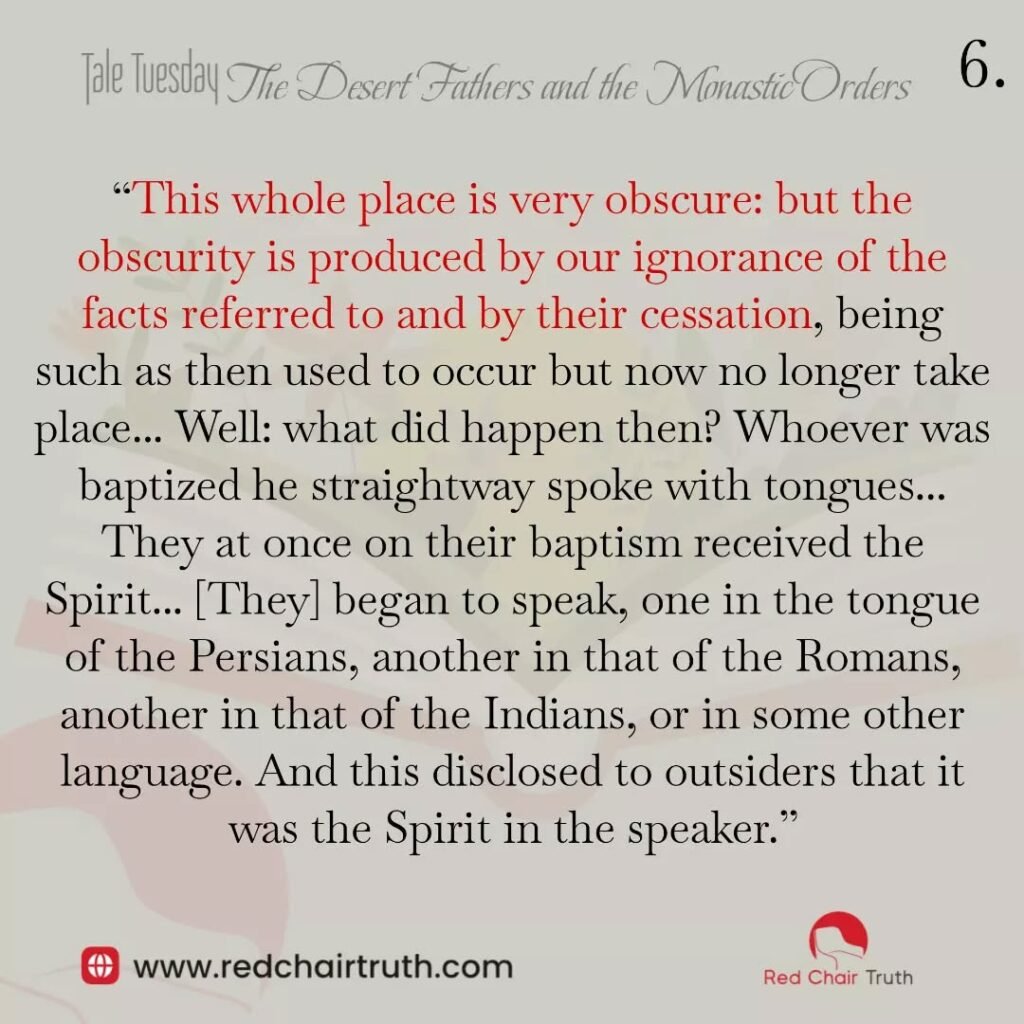
“This whole place is very obscure: but the obscurity is produced by our ignorance of the facts referred to and by their cessation, being such as then used to occur but now no longer take place… Well: what did happen then? Whoever was baptized he straightway spoke with tongues… They at once on their baptism received the Spirit… [They] began to speak, one in the tongue of the Persians, another in that of the Romans, another in that of the Indians, or in some other language. And this disclosed to outsiders that it was the Spirit in the speaker.”

Tale Tuesday 026
Date: 31st January 2023
Title: The Desert Fathers and the Monastic Orders
Source: The Azusa Street Revival
Author: Roberts Liardon
Previous post
Next post