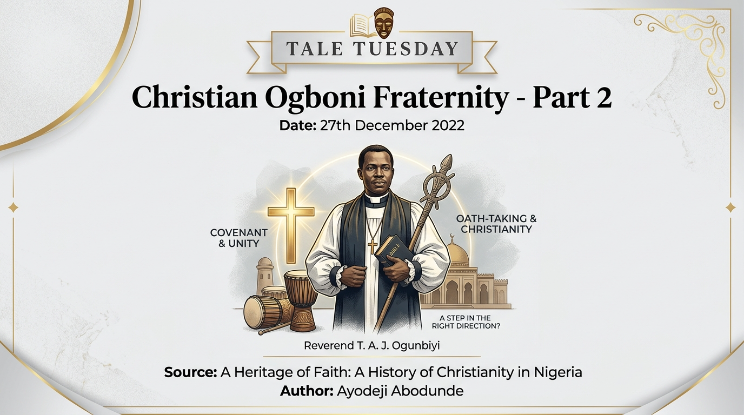
Scriptural Justification for the Christian Ogboni Society
Ogunbiyi believed he was “taking a step in the right direction, spiritually and culturally.” Nehemiah 10:29 formed the basis of his arguments for the scriptural credibility of the new organisation: “These joined with their brethren, their nobles and entered into a curse and an oath to walk in God’s law, which was given by Moses the servant of God, and to observe and do all the commandments of the LORD our Lord, and His ordinances and His statutes.” The word “noble” in this verse is translated “ogboni” in the Yoruba Bible.
Oath-Taking as Covenant and Moral Control
Ogunbiyi also interpreted the use of the word “oath” here to mean that God was to be worshipped by oath-taking, so that Christians would have a greater sense of covenant and unity. He believed the taking of oaths would confer a sense of fear, which would ensure that members adhered to the commandments of Christianity. He also reasoned that the laws of Christianity would be kept if it was organized in the form of a cult. His intention was to enforce “the moral code of Christianity and genuine brotherliness by fear.” Ogunbiyi sought to combine indigenous traditional religion with Christianity.
Christianity and Yoruba Religious Values
He saw Christianity as it was being practiced as cold, and he judged that adding certain values of traditional Yoruba religion to it would supply the missing edge. The Christian Ogboni Society did not consider itself as introducing heathenism into Christianity; rather, it was shedding the light of the Christian faith on Ogboni cultic practices. They considered themselves the exponents of the best form of Christianity. Ogunbiyi said it was his purpose to “purge this wonderfully helpful craft [the Ogboni cult] of its decidedly objectionable heathenish customs and thus convert it to a precious jewel compared with the same jewel in the dust.”
READ ALSO: WILLIAM & CATHERINE BOOTH (PART 22)
Initiation Rites and Pagan Elements
The oaths taken during the initiation rites were pagan. During the rites, the initiate’s face would be covered and the hands tied at the back. The person was then made to kneel thrice to two brazen images, while the officiating minister pronounced certain words. The Bible would then be enclosed in a calabash. Christian songs and prayers were used to open and end the meetings. One of the signs of the cult was a three-finger salute which outsiders were made to believe represented the Trinity.
Opposition from the Anglican Church
Herbert Tugwell and Isaac Oluwole opposed the society and forbade the use of the name Christian in connection with it. The Anglican ministers who were members of the society were asked to leave, and Ogunbiyi was instructed to drop the idea.
Suspension and Revival of the Society
Owing to Tugwell’s resistance to the society, Ogunbiyi in 1916 suspended its activities. It remained non-functional for the next fifteen years. The society resumed operations in 1932 after Ogunbiyi had fallen out with the Christian Missionary Society, and his licence had been revoked. He thereafter started his own church in Ikeja.
Transformation into the Reformed Ogboni Fraternity
In the 1940s, he came back into prominence in the Anglican Church when L. G. Vining, who later became the Anglican Archbishop of the Province of West Africa, gave him the right hand of fellowship. At this time the word “Christian” was dropped from the society’s name and a new name—the Reformed Ogboni Fraternity—was adopted. The society was registered with the government in 1943. It also ceased to be strictly for Christians, as men of all religious persuasions were now free to belong

Tale Tuesday 023
Date: 20th December, 2022
Title: Christian Ogboni Fraternity- part 1
Source: A Heritage of Faith: A History of Christianity in Nigeria
Author: Ayodeji Abodunde
Previous post
Next post