Last week, we saw how God expects us to honour our parents by supporting them financially. But what about those who are still young, not yet earning, or unable to give money? Does that mean they have nothing to offer?
Before we journey into the Scriptures to discover how honour was shown in ancient times, let us consider some ways children can honour their parents without a paycheck.
There is Always Something You Can Give…
If you are young, most times, your parents don’t want your money. And when you’re older, there are some parents who don’t need money. They are fine and doing well financially. But does that exempt the child from giving them honour? Not at all.
Parents would treasure even something as simple as:
- A bottle of groundnut
- Some cashew nuts
- A pair of slippers or sandals, or
- Any simple small thing you know they like
A simple “I thought of you” gift. That can be a way of honouring them. Sometimes all they need is that assurance that their child has not forgotten them.
Many have never done this, not because they lack money, but for lack of training. Honour is a mindset before it becomes an action.
Children Who Give Nothing But Their Appetite
Many young people treat their parents as though the parents exist to serve them.
It’s normal to hear students, especially those in university, call home close to holiday time to say, “I’m coming home… please prepare this for me.” They are like small lords and ladies.
While it is not wrong to express desire (in a tone like, “Mummy, I’ve missed this soup, please, I hope you’ll make it…”), even though I wonder if the holiday is meant to last for just two or three days. Why don’t you wait until you get home and ask? That might be more polite. The problem is that you expect to be served, yet you give nothing in return.
When you go home on holidays as a student, honour your parents by helping out at the house and being resourceful. Be involved in the family business, clean the house, run errands, wash their clothes, and deep-clean their rooms.
Let them feel the difference because you are around. Don’t just be an extra mouth to feed. Contribute. Assist with chores and let them be grateful that you’re home.
In obedience to these teachings I’ve heard many testimonies from children whose parents openly expressed how much of a blessing they were during the holidays; sharing stories of gifts, favour, and other good things the parents freely gave them simply because they were pleased with them.
One said the mother of the house (his sister-in-law), asked him, “What would you like to eat?” This is a question she had never asked before. I’ve heard of terrible and harsh fathers giving their children money for the first time, or expressing a gentle side that the child had never seen all their life. All these because they simply obeyed my teachings on honouring their parents and guardians.
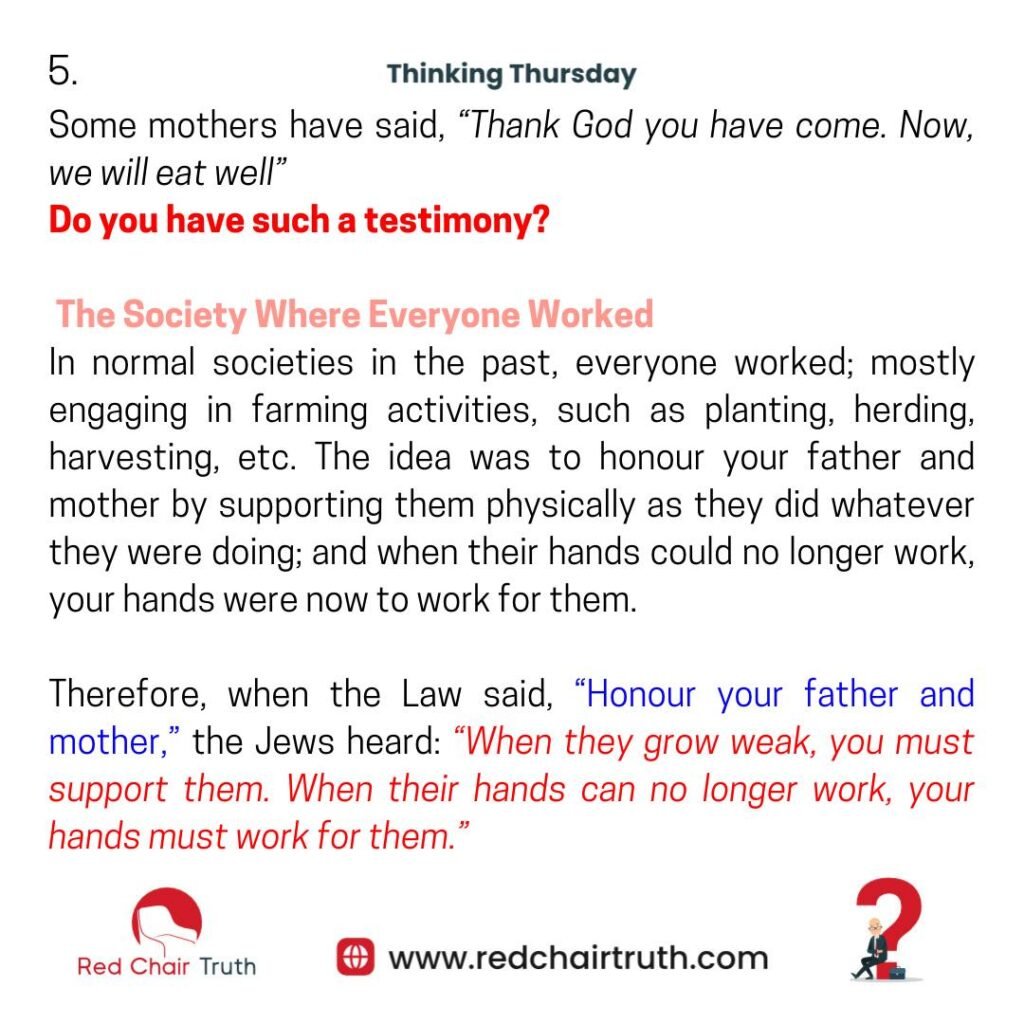
Some mothers have said, “Thank God you have come. Now, we will eat well”
Do you have such a testimony?
PREVIOUS EPISODE:HONOUR (PART 9)
The Society Where Everyone Worked
In normal societies in the past, everyone worked; mostly engaging in farming activities, such as planting, herding, harvesting, etc. The idea was to honour your father and mother by supporting them physically as they did whatever they were doing; and when their hands could no longer work, your hands were now to work for them.
Therefore, when the Law said, “Honour your father and mother,” the Jews heard: “When they grow weak, you must support them. When their hands can no longer work, your hands must work for them.”
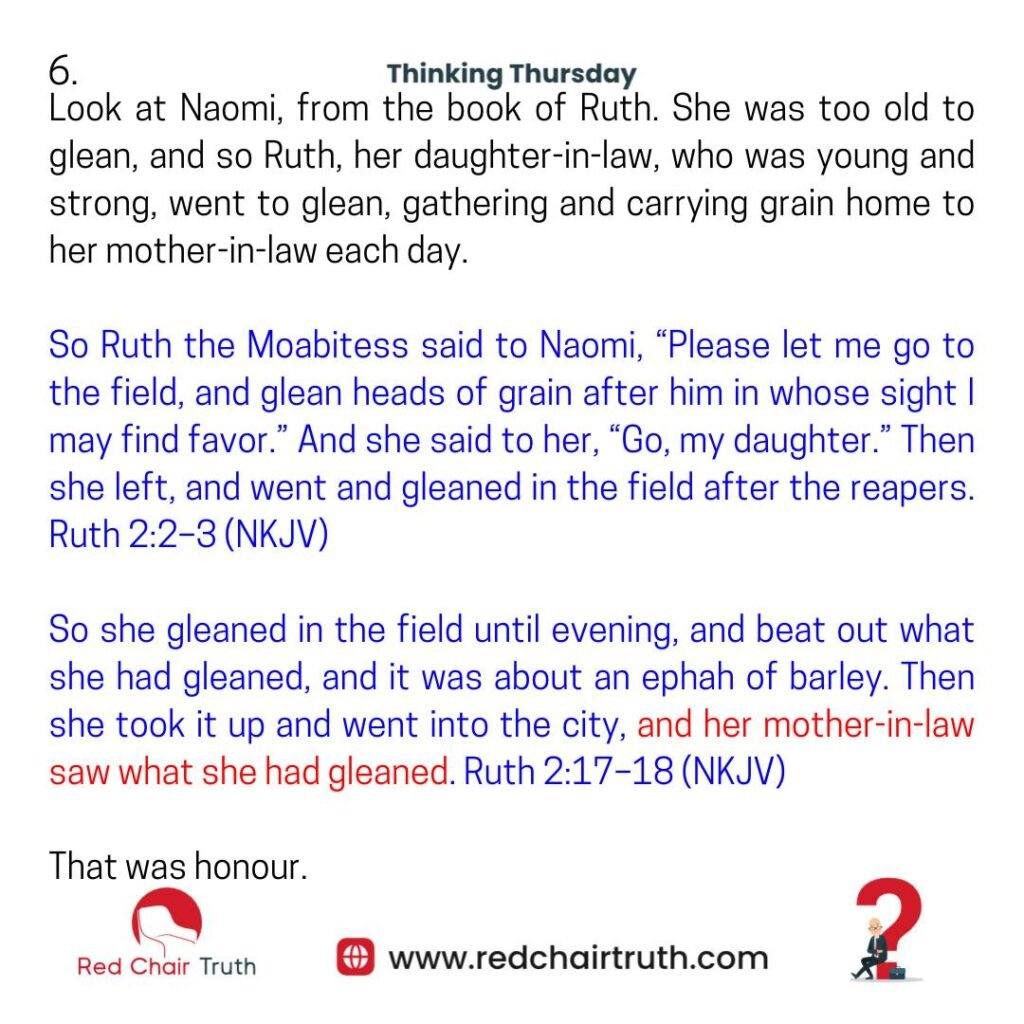
Look at Naomi, from the book of Ruth. She was too old to glean, and so Ruth, her daughter-in-law, who was young and strong, went to glean, gathering and carrying grain home to her mother-in-law each day.
So Ruth the Moabitess said to Naomi, “Please let me go to the field, and glean heads of grain after him in whose sight I may find favor.” And she said to her, “Go, my daughter.” Then she left, and went and gleaned in the field after the reapers. Ruth 2:2-3 (NKJV)
So she gleaned in the field until evening, and beat out what she had gleaned, and it was about an ephah of barley. Then she took it up and went into the city, and her mother-in-law saw what she had gleaned. Ruth 2:17-18 (NKJV)
That was honour.
READ ALSO: WHO’S THE JUDGE?
Lesson’s From Jacob’s Life
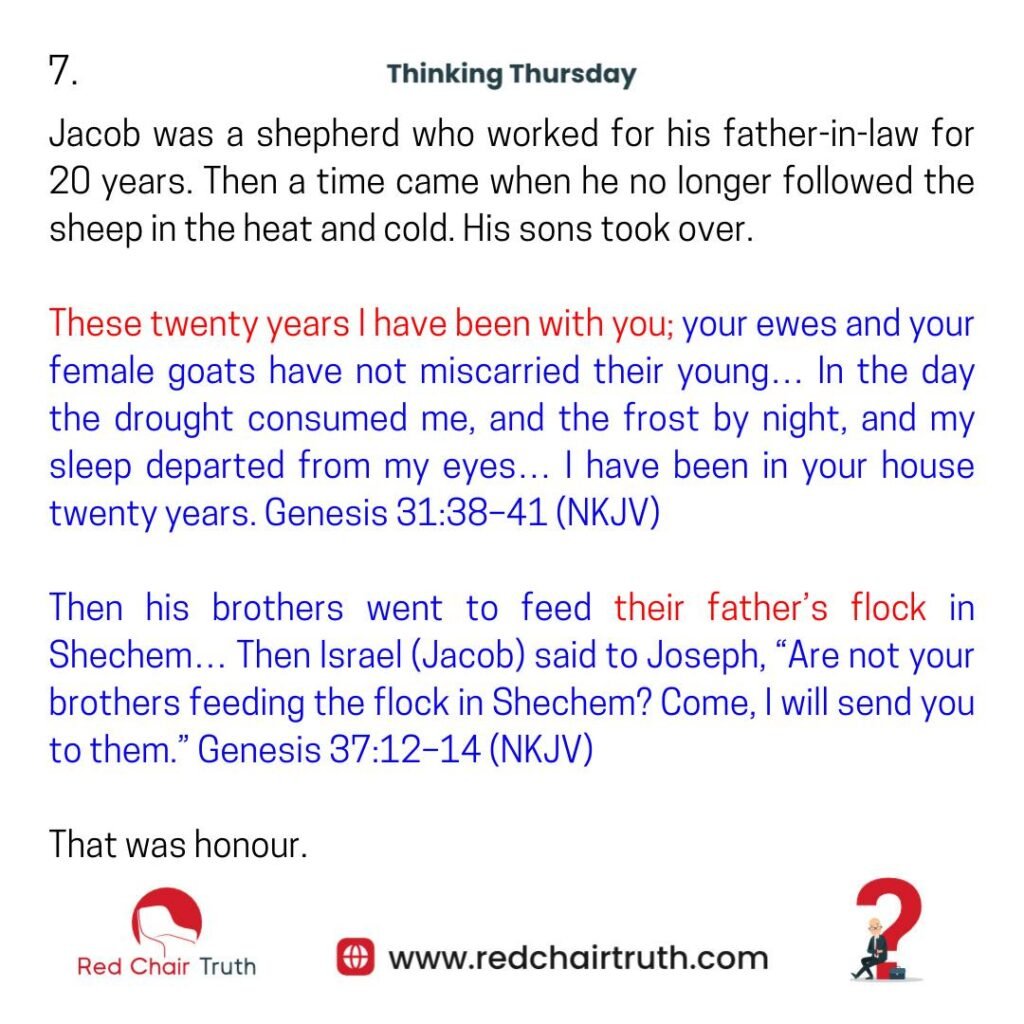
Jacob was a shepherd who worked for his father-in-law for 20 years. Then a time came when he no longer followed the sheep in the heat and cold. His sons took over.
These twenty years I have been with you; your ewes and your female goats have not miscarried their young… In the day the drought consumed me, and the frost by night, and my sleep departed from my eyes… I have been in your house twenty years. Genesis 31:38-41 (NKJV)
Then his brothers went to feed their father’s flock in Shechem… Then Israel (Jacob) said to Joseph, “Are not your brothers feeding the flock in Shechem? Come, I will send you to them.” Genesis 37:12-14 (NKJV)
That was honour.
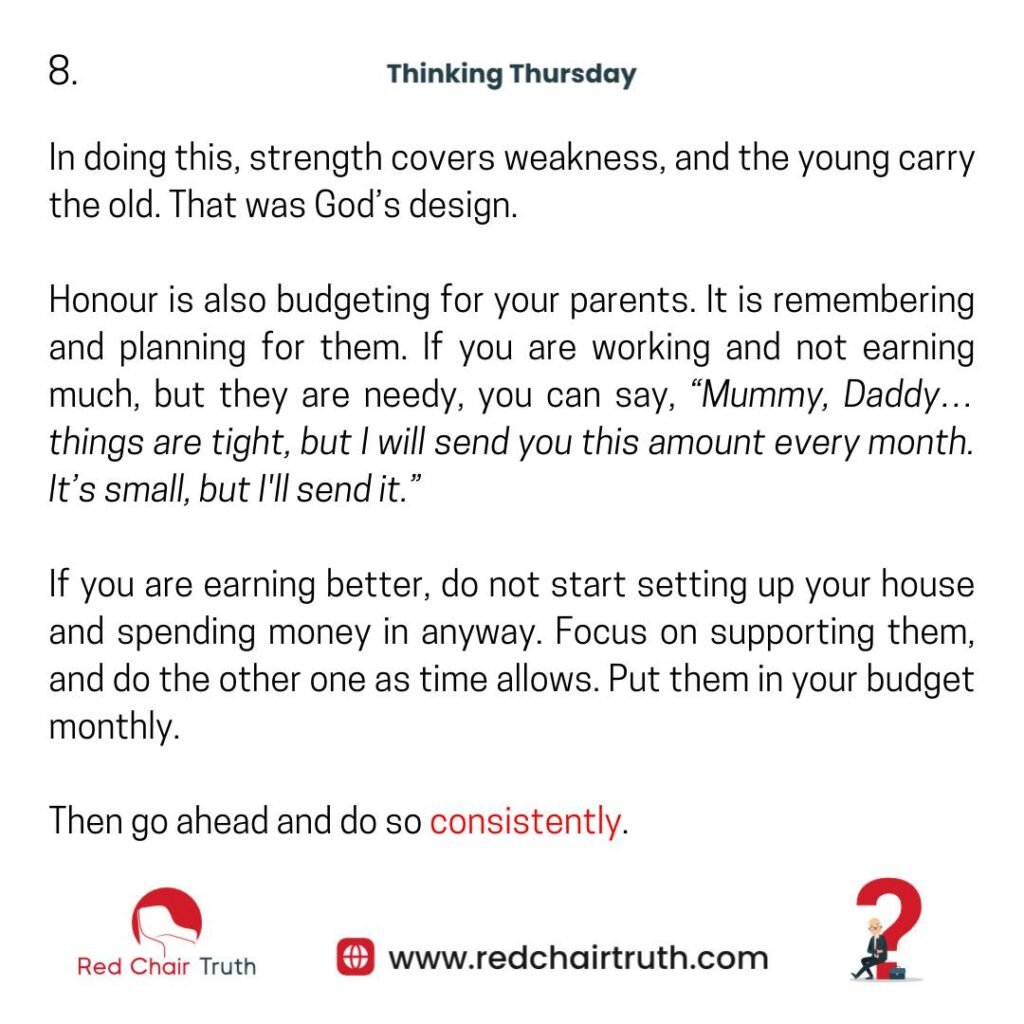
In doing this, strength covers weakness, and the young carry the old. That was God’s design.
Honour is also budgeting for your parents. It is remembering and planning for them. If you are working and not earning much, but they are needy, you can say, “Mummy, Daddy… things are tight, but I will send you this amount every month. It’s small, but I’ll send it.”
If you are earning better, do not start setting up your house and spending money in anyway. Focus on supporting them, and do the other one as time allows. Put them in your budget monthly. Then go ahead and do so consistently.
READ NEXT: HONOUR (PART 11)