

Early Life and Background
William J. Seymour was born on May 2, 1870, in Centerville, Louisiana. His parents, Simon and Phyllis, were freed from slavery only a few years earlier. Seymour was born in a time when racial prejudice was rampant. The Jim Crow laws represented the legitimization of anti-black racism. Sadly, discrimination and segregation were also prevalent in the churches, and many Christian ministers and theologians taught that whites were the “chosen people,” blacks were cursed to be servants, and God supported racial segregation. Many in those days did not believe that blacks even had a soul.
Young Seymour “found his identity in Jesus Christ, believing that the Lord was the only liberator of mankind.” He was a sensitive, high-spirited youth, and hungry for the truth of God’s Word. With no formal education, like many others in those times, he taught himself to read by constantly reading the Bible. He was christened in the Roman Catholic church and was probably raised in the Catholic church, although some believe that he was raised as a Baptist.
Move to Indianapolis and Spiritual Formation
Seymour arrived in Indianapolis, Indiana at the age of 25 and found work as a waiter in some of the city’s finest restaurants. Not long after his arrival, Seymour joined the A.B. Simpson Chapel Methodist Episcopal Church. This branch of the Northern Methodists had a strong evangelistic outreach to all classes, which appealed greatly to Seymour. Their passion to reach out to all helped Seymour formulate his belief that there is no color line in the redemption of Christ.
In 1895 Seymour moved to Cincinnati, Ohio, where he continued to work as a waiter. While there he came into contact with holiness teachings through Martin Wells Knapp’s God’s Revivalist movement and Daniel S. Warner’s Church of God Reformation movement, otherwise known as the Evening Light Saints. Believing that they were living in the twilight of human history, these Christians believed that the Spirit’s outpouring would precede the rapture of the Church. These teachings deeply impressed the young Seymour.
READ ALSO: MARIA WOODWORTH-ETTER
His Call to Ministry and Smallpox Experience
It was while he was with this group that he received his call to the ministry-a call he wrestled with. In the midst of the struggle, he contracted smallpox, which was usually fatal in that time. He survived three weeks of horrible suffering and was left with blindness in his left eye and severe facial scarring. After his recovery, he immediately submitted to the call of God and was licensed and ordained as a minister by Evening Light Saints. Soon, he began traveling as an itinerant preacher. Seymour left Cincinnati sometime in 1902, and there remains uncertainty regarding his whereabouts until he arrived in Houston, Texas, in 1905.
The Jim Crow laws of the day prevented blacks and whites from congregating together; therefore, there were no blacks allowed in the school. Seymour, though, showed up at Charles Parham’s school asking for entrance. Because of the policy of segregation, Parham was reluctant, but sensing Seymour’s great spiritual hunger, he eventually allowed him to attend. Parham, also sensitive to the local Jim Crow laws, admitted Seymour to the Bible school but did not allow him to sit in the classroom with the white students. Consequently, Seymour sat in an adjoining room where, through an open door, he absorbed the daily teachings on the Holy Spirit baptism.
Despite the impositions from Parham, Seymour was not deterred, and because of the intensity of his spiritual hunger, he did extremely well in school. William Seymour was not a theologian with a compelling presence of commanding speech. He was a humble, one-eyed black man with light beard and a face scarred by smallpox who came from Houston, Texas, with the Pentecostal message burning in his heart.
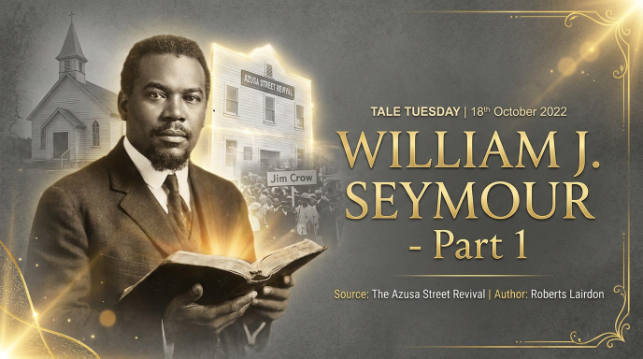
Date: 18th October 2022
Title: WILLIAM J. SEYMOUR- Part 1
Source: The Azusa Street Revival
Author: Roberts Liardon
Tale Tuesday 013
Previous post
Next post