

Spiritual Leaders 5
Just Another One of Them?
In a world where scandals spread faster than truth, it’s easy to write off a man of God when you hear something negative about them. What once might have stayed within a local church or ministry now becomes global news in a matter of minutes.
Because of this, many people (both believers and non-believers) now approach spiritual leadership with caution, suspicion, and sometimes deep cynicism. Some people see a man of God and think, “Who knows what this one is hiding?”
So, when a rumour surfaces, an allegation is whispered, or a social media post appears, there is a strong temptation to accept it immediately, repeat it quickly, and mentally file that leader away as “just another one of them.”
Watch Yourself…
You have to be aware that a lot may have happened in the past with some of the heroes of the faith that are unknown, but you still accept them. I’ve heard some troubling ones.
While I believe that God is cleaning up His church from even such hidden sins, we must not be so harsh that we run afoul of Gal. 6:1, which states: Brothers, if someone is caught in a sin, you who are spiritual should restore him gently. But watch yourself, or you also may be tempted (NIV).
God’s Word is Settled… Forever
The truth is, God does not suspend His Word because leaders have abused their positions of authority. The Bible gives very clear instructions on how accusations against spiritual leaders are to be handled, and those instructions are not optional, even in an age of exposure.
1 Tim. 5:19 says, Against an elder receive not an accusation, but before two or three witnesses.
The very next verse makes it clear that persistent false accusers are not to be excused: Them that sin rebuke before all, that others also may fear (1 Tim. 5:20 KJV).
The Bible says that those who falsely accuse leaders persistently should be rebuked publicly, so that others will see it and fear. Most Christians interpret 1 Tim. 5:20 to mean that leaders who sin should be reprimanded, but a look at the Law, from which this principle is derived, gives us clarity about the matter.
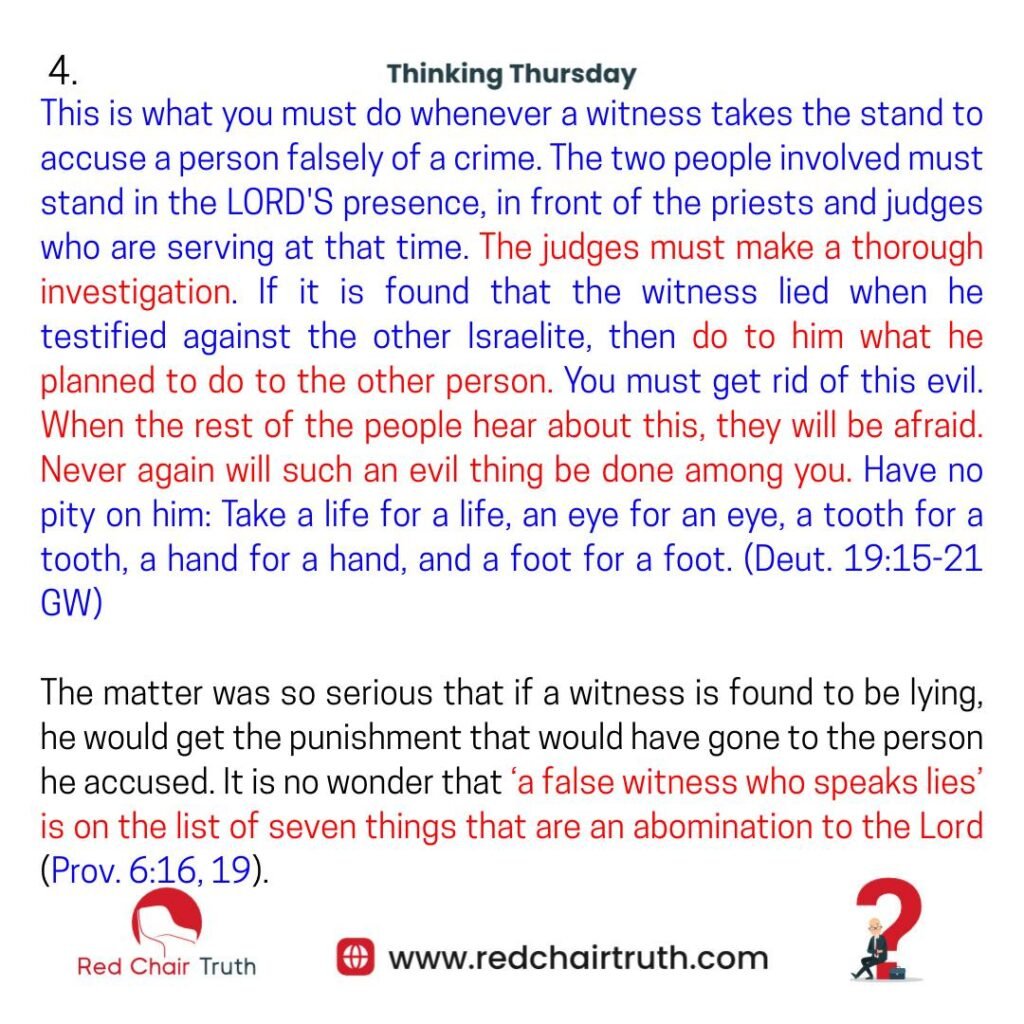
The Law states: One witness is never enough to convict someone of a crime, offense, or sin he may have committed. Cases must be settled based on the testimony of two or three witnesses.
This is what you must do whenever a witness takes the stand to accuse a person falsely of a crime. The two people involved must stand in the LORD’S presence, in front of the priests and judges who are serving at that time. The judges must make a thorough investigation. If it is found that the witness lied when he testified against the other Israelite, then do to him what he planned to do to the other person. You must get rid of this evil. When the rest of the people hear about this, they will be afraid. Never again will such an evil thing be done among you. Have no pity on him: Take a life for a life, an eye for an eye, a tooth for a tooth, a hand for a hand, and a foot for a foot. (Deut. 19:15-21 GW)
The matter was so serious that if a witness is found to be lying, he would get the punishment that would have gone to the person he accused. It is no wonder that ‘a false witness who speaks lies’ is on the list of seven things that are an abomination to the Lord (Prov. 6:16, 19).
God Doesn’t Treat Rebels with Kids’ Gloves
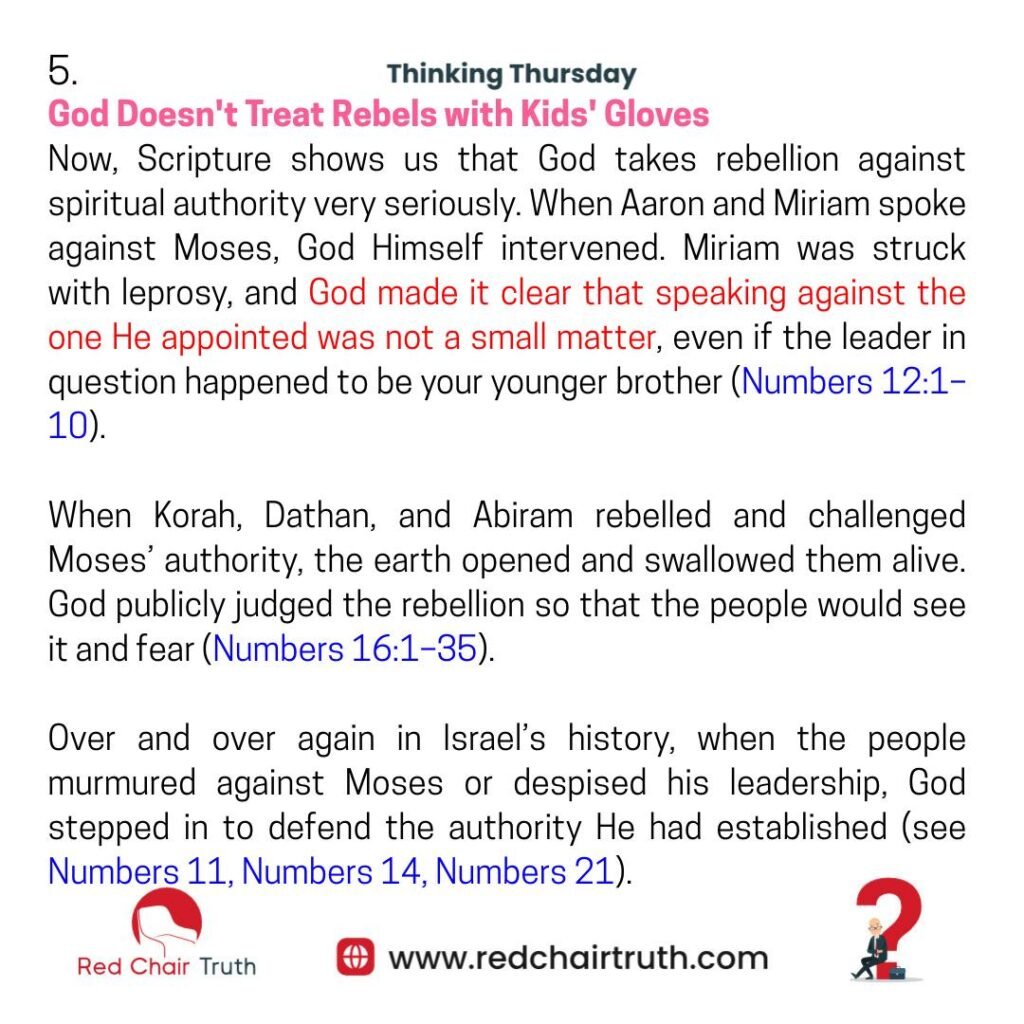
Now, Scripture shows us that God takes rebellion against spiritual authority very seriously. When Aaron and Miriam spoke against Moses, God Himself intervened. Miriam was struck with leprosy, and God made it clear that speaking against the one He appointed was not a small matter, even if the leader in question happened to be your younger brother (Numbers 12:1-10).
When Korah, Dathan, and Abiram rebelled and challenged Moses’ authority, the earth opened and swallowed them alive. God publicly judged the rebellion so that the people would see it and fear (Numbers 16:1-35).
Over and over again in Israel’s history, when the people murmured against Moses or despised his leadership, God stepped in to defend the authority He had established (see Numbers 11, Numbers 14, Numbers 21).
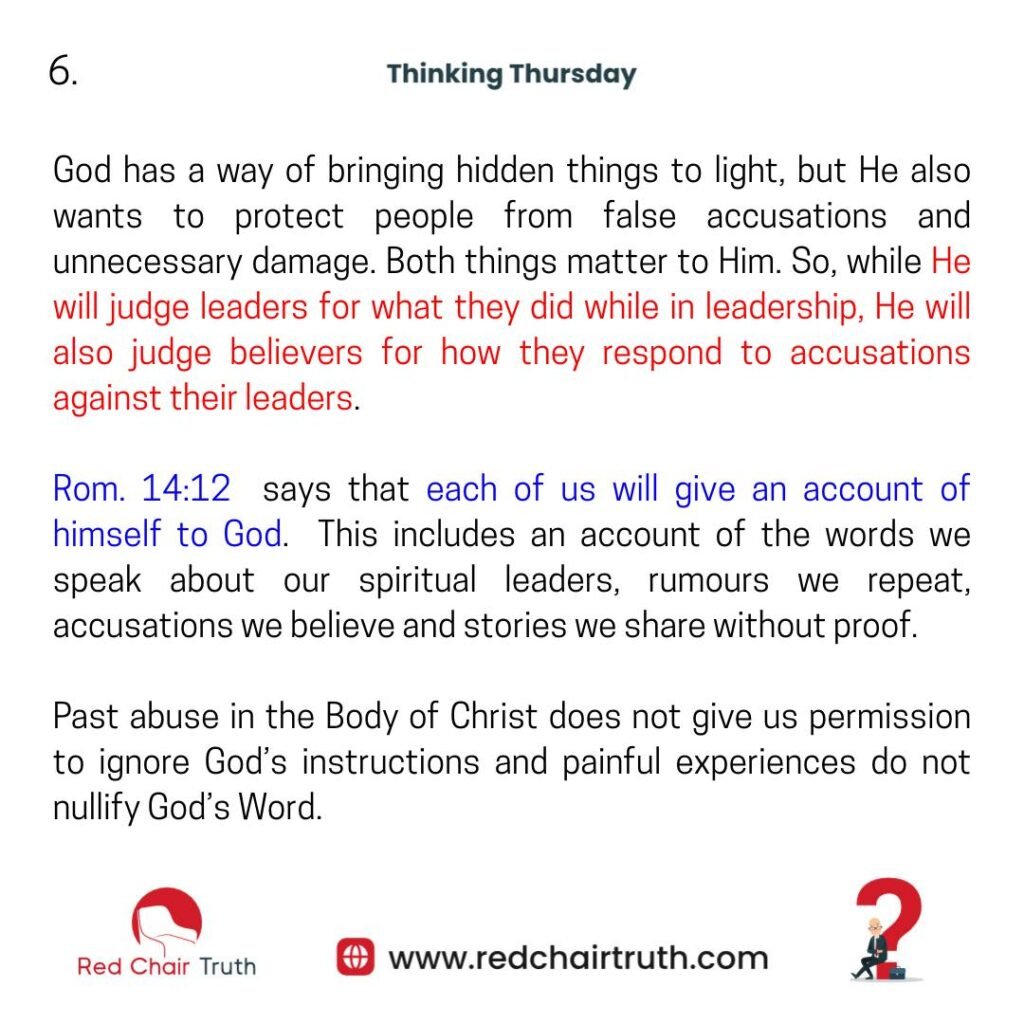
God has a way of bringing hidden things to light, but He also wants to protect people from false accusations and unnecessary damage. Both things matter to Him. So, while He will judge leaders for what they did while in leadership, He will also judge believers for how they respond to accusations against their leaders.
Rom. 14:12 says that each of us will give an account of himself to God. This includes an account of the words we speak about our spiritual leaders, rumours we repeat, accusations we believe and stories we share without proof.
Past abuse in the Body of Christ does not give us permission to ignore God’s instructions and painful experiences do not nullify God’s Word.
But Does This Mean Turn a Blind Eye?
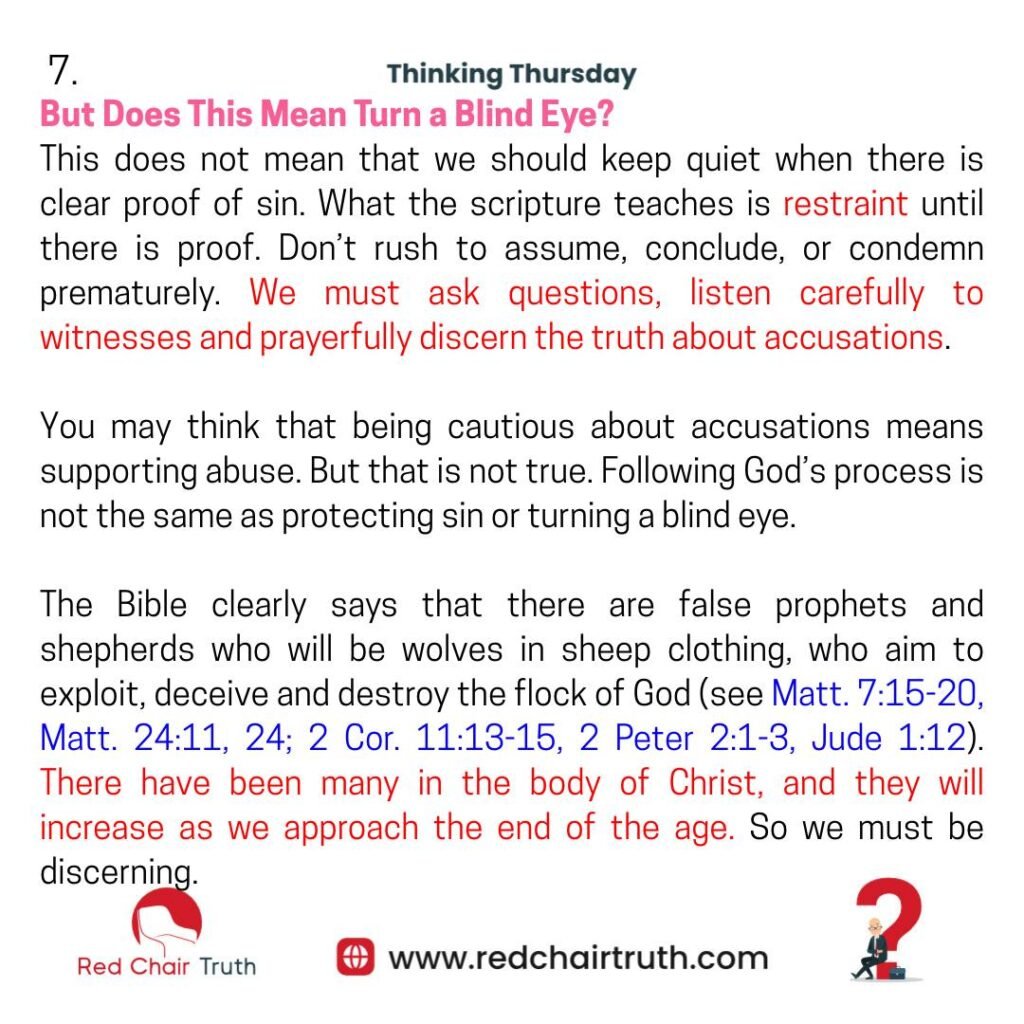
This does not mean that we should keep quiet when there is clear proof of sin. What the scripture teaches is restraint until there is proof. Don’t rush to assume, conclude, or condemn prematurely. We must ask questions, listen carefully to witnesses and prayerfully discern the truth about accusations.
You may think that being cautious about accusations means supporting abuse. But that is not true. Following God’s process is not the same as protecting sin or turning a blind eye.
The Bible clearly says that there are false prophets and shepherds who will be wolves in sheep clothing, who aim to exploit, deceive and destroy the flock of God (see Matt. 7:15-20, Matt. 24:11, 24; 2 Cor. 11:13-15, 2 Peter 2:1-3, Jude 1:12). There have been many in the body of Christ, and they will increase as we approach the end of the age. So we must be discerning.
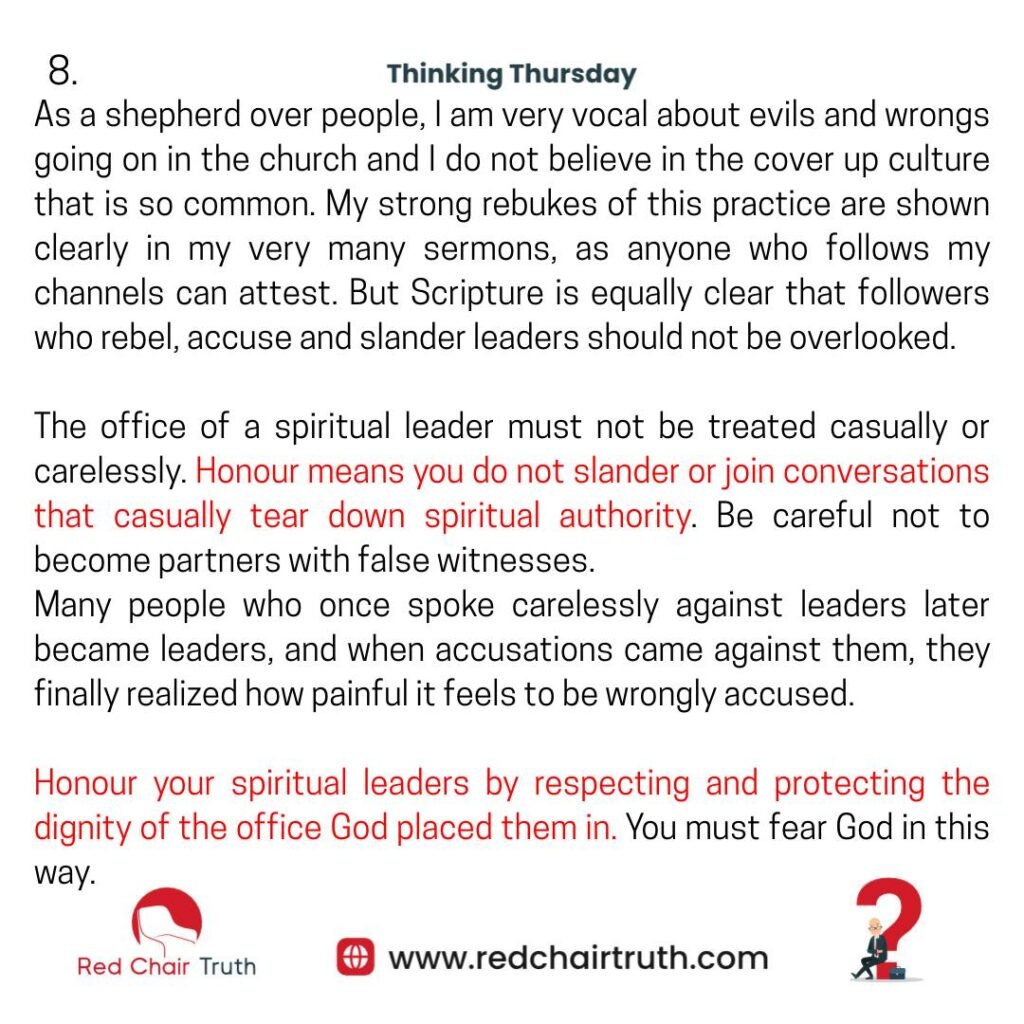
As a shepherd over people, I am very vocal about evils and wrongs going on in the church and I do not believe in the cover up culture that is so common. My strong rebukes of this practice are shown clearly in my very many sermons, as anyone who follows my channels can attest. But Scripture is equally clear that followers who rebel, accuse and slander leaders should not be overlooked.
The office of a spiritual leader must not be treated casually or carelessly. Honour means you do not slander or join conversations that casually tear down spiritual authority. Be careful not to become partners with false witnesses. Many people who once spoke carelessly against leaders later became leaders, and when accusations came against them, they finally realized how painful it feels to be wrongly accused.
Honour your spiritual leaders by respecting and protecting the dignity of the office God placed them in. You must fear God in this way.
READ NEXT: HONOUR (PART 20)