Transformation through World Evangelism Vision
While in Dallas, Idahosa read a book on world evangelism by T. L. Osborn and was profoundly affected. For three days, he wept, prayed, and fasted over the message of the book.
His soul was burdened with the need to reach the millions of souls in Nigeria that had not known Christ. He immediately applied to return to Nigeria, even though he had not completed his programme. Lindsay accepted, and Idahosa quickly returned to Nigeria.
Idahosa was a changed man. He now burned with the passion to see the world saved. He was being transformed from the Benin evangelist into a national and global crusader.
Formation of a National Evangelistic Vision
His first major move upon returning to Nigeria was to start an organization with the same name as Lindsay’s: Christ for the Nations International Evangelistic Association.
He invited all the pastors in Benin to a meeting. There, they discussed the formation of a fellowship of evangelists to reach Benin and all of Nigeria. However, they received the message with indifference. Idahosa concluded that he would have to forge ahead alone.
He called his elders and his mentor, Elton, to discuss a plan to reach all of Nigeria. Together, they took a map of Nigeria and divided the country into four sections. They then decided to schedule an evangelistic crusade in each section.
The Ogbe Stadium Crusade and Nationwide Expansion
The first target was the mid-western region. They booked Ogbe Stadium, with a seating capacity of 60,000, for five days, February 25–29, 1972.
The crusade received wide publicity. Adverts ran on the radio. A sound truck drove through the city. Posters and handbills were also distributed.
No one knew what response the community would give. However, to Idahosa’s thrill, 5,000 people gathered in the stadium on the first night.
The crowds steadily grew and reached about 10,000 on the closing night. Hundreds were saved, and many miracles were recorded. In the following months, crusades took place in the other three regions with similar results.
From this point on, there was no stopping Idahosa.
READ ALSO: WILLIAM & CATHERINE BOOTH (PART 18)
A New Model of Church and Vision Partnership
In a radical departure from older Pentecostal practice, his church adopted the name “Church of God Mission International.” The church regarded Idahosa as the carrier of the vision and saw itself as a partner with him.
In essence, the preacher had become the icon of the message, while the church served as the support base of the vision. Perhaps this unalloyed support for the “man sent by God” was one of the most important factors in Idahosa’s rise to global influence.
Crusades as the Gold Standard of Charismatic Evangelism
Idahosa’s crusades became the gold standard of charismatic evangelism. He followed the pattern of T. L. Osborn, who was then the most successful international Pentecostal evangelist.
Idahosa was re-enacting Osborn’s feats on a national scale. Miracles, healings, the manifestation of the gift of faith, deliverance, and an open challenge to occult powers were major features of the crusades.
Furthermore, Idahosa began to explore initiatives that would define charismatic Christianity in Nigeria and Africa for decades. He boldly rallied people around his vision.
Rapid Church Growth and National Impact
By 1973, the church’s headquarters in Benin regularly recorded an attendance of about 2,000. Three other branches had also opened in the city, along with more than 100 branches throughout the country.
Meanwhile, the crusades continued on a massive scale in Warri, Agbor, Sapele, Auchi, Owerri, Ilorin, Owo, and in major towns and cities.
The whole nation watched in awe as Idahosa’s programmes shook towns and cities and reshaped the Pentecostal landscape.

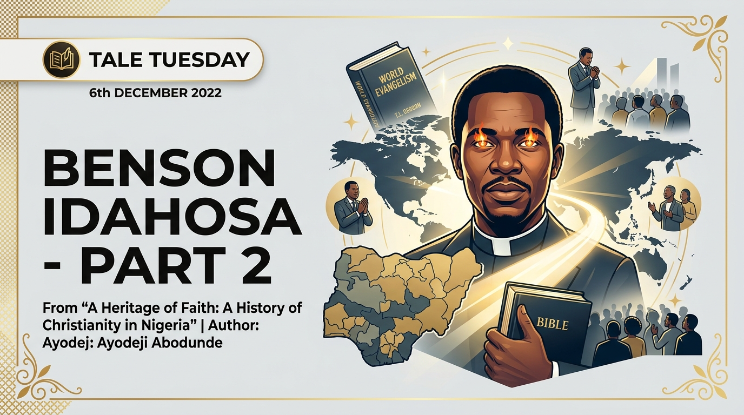
Tale Tuesday 020
Date: 6th December, 2022
Title: BENSON IDAHOSA- Part 2
Source: A Heritage of Faith: A History of Christianity in Nigeria
Author: Ayodeji Abodunde
Previous post
Next post