

A Blunt Observation
“You have prayed enough since I have attended these meetings to have prayed the devil out of Adams, if there was any virtue in your prayers. But here you are praying on, and complaining still.”
Despite the candor of his remarks, Charles didn’t intend them to be insulting. They were merely an expression of his honest pursuit of real answers.
A Growing Restlessness
Restlessness grew within him as he realized that he needed a Savior. However, he could find no one who could tell him how to properly seek Him.
Calvinistic Barriers to God
One of the issues Charles struggled with had also driven a wedge between George Whitefield and the Wesley brothers. Despite what had happened during the First Great Awakening, New England churches—especially Presbyterian churches—remained staunchly Calvinistic.
They preached God’s sovereignty as supreme in all matters, especially salvation. Accordingly, they taught that those who were saved were the “elect,” whom God had “predestined” to receive salvation through the cross. Jesus’ sacrifice, therefore, covered their sins alone. According to this teaching, Jesus died only for these elect and no one else.
A Crisis of Faith
Thus, no individual could know for certain whether he or she was saved. Salvation depended on the will of God. Everyone was still expected to live a holy life before a holy God. Otherwise, they would provoke God’s wrath, which Jonathan Edwards and those like him had so aptly described.
However, they knew little about responding to God’s love and mercy.
READ ALSO: WILLIAM AND CATHERINE BOOTH (PART 4)
A Choice to Make
When Charles applied the same logic he used in preparing legal cases to his Bible reading, he saw what he considered the Calvinists’ basic failure. They believed what was preached from the pulpit instead of what they read in the Bible.
He reasoned that if God were a good and righteous judge, and if the Bible were His written Word and law to humanity, then either the Bible was a lie or the Calvinists were following a delusion.
Once he reached this conclusion, he knew he had only two choices: “accept Christ as presented in the Gospel, or pursue a worldly life.”
Is God a Lie?
On a Saturday evening in October 1821, twenty-nine-year-old Charles decided to settle the question of his soul’s future once and for all. Either he would make his peace with God, or God was a lie and the Bible a fabrication.
Since he found no answers in the church and received no help from its members, he knew he would have to find his answers by studying the Bible and seeking God in prayer.
A Secret Pursuit
Although Charles still had to spend long hours in the law office, he decided to put his work aside as much as possible until he resolved the issue.
Oddly, he suddenly felt timid and ashamed when people saw him with a Bible or heard him praying. When he first purchased his Bible, he had read it openly at work. He had even left it lying open when others met with him.
Now, however, he would throw a law book over his Bible whenever someone entered the office to conceal it.
A Desperate Struggle
Charles kept his Bible out of sight as much as possible. He also stopped up the keyhole to his office and whispered his prayers because he feared someone might hear him praying for the salvation of his soul.
He spent Monday and Tuesday of that week in anguish. By Tuesday night, fear had virtually paralyzed him. He feared that he would die and go to hell because he could not find the voice to cry out to God for His mercy.
To be continued…
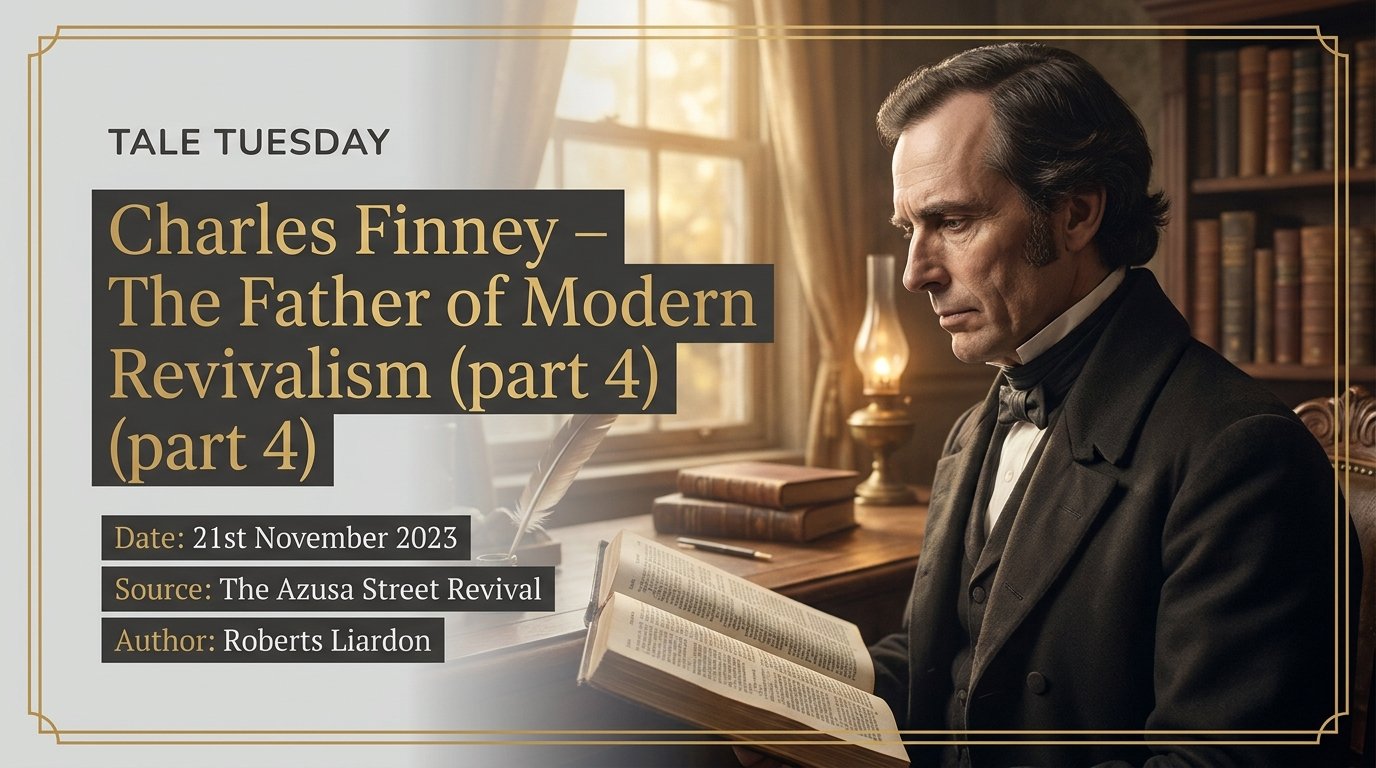
Tale Tuesday 064
Date: 21st November, 2023
Title: : Charles Finney – The Father of Modern Revivalism(part 4)
Source: The Azusa Street Revival
Author: Roberts Liardon
Previous post
Next post