

The First Major Attack
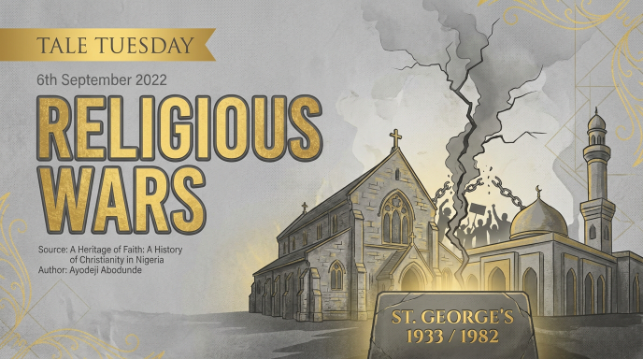
The first major direct violent attack against Christianity in Nigeria occurred in October 1982. The Muslim Student Society of Nigeria (MSSN) protested the location of St. George’s Anglican Church in Fagge, Kano City. They argued that the church stood too close to a mosque.
However, this argument raised questions. The church had stood on the site since 1933, about forty years before the mosque was built. The protest reflected growing tensions over the increasing presence of Christianity in the area.
In April 1982, Robert Runcie, the Archbishop of Canterbury, had visited Nigeria. One highlight of his visit was the laying of the foundation stone for a new church building on the site of the old St. George’s Church.
The protest soon developed into a wider crisis. At least eight churches suffered vandalism, while forty-four people lost their lives. Fortunately, the police intervened quickly and saved St. George’s Church from destruction.
The University of Ibadan Conflict
In 1985, the conflict temporarily shifted to western Nigeria. This time, the dispute centred on an academic community: the University of Ibadan.
The crisis began when Muslim students objected to a cross in front of their mosque. The cross stood on the eastern side of the building and had remained there for almost two decades.
Following the commissioning of the new mosque, Muslim leaders demanded that the university remove the cross. At the opening ceremony, the mosque’s financiers, Moshood Abiola and Alao Arisekola, also called for a more Islamic orientation to the university’s curriculum.
The mosque’s management committee later sent a letter to the vice-chancellor. Its title read, “Request for the removal of cross from the front of new mosque.”
When the chapel received the letter, its members strongly opposed the demand. Consequently, a prolonged dispute followed.
The controversy soon spread beyond the university. Newspapers, television stations, and radio stations across Nigeria covered the dispute. After several years of tension, both sides eventually reached a compromise.
The university erected a screen to block the view of the cross from the mosque. Later, the Muslim community built a large crescent to rival the cross. The controversy finally came to an end in September 1987.
READ ALSO: HISTORY OF THE CHURCH IN ZARIA
The Kafanchan Crisis
By 1987, the battleground had shifted to Kafanchan. The crisis began at the College of Education, Kafanchan, during Mission ’87, a programme organised by the Fellowship of Christian Students (FCS).
Mission ’87 was an annual programme and a regular feature of Christian activities in Nigerian institutions of higher learning. However, Muslim students viewed the event as an opportunity to challenge Christian witness at the school.
The immediate dispute centred on a banner that the FCS placed at the school entrance. It read: “WELCOME TO MISSION ’87 ON JESUS CAMPUS.”
Muslim students objected to the banner and complained to the school authorities. The authorities then ordered the FCS leaders to remove it. The Christian students promptly complied.
Nevertheless, violence later erupted during the programme. The guest speaker, Abubakar Bako, referred to the Quran while attempting to illustrate a point. Tensions escalated, and the situation eventually developed into a wider crisis.
Escalation in the 1990s
During the 1990s, violent clashes between Christians and Muslims escalated across Nigeria.
Several major riots occurred during the decade. These included Bauchi in April 1991 and July 1995; Kano in October 1991 and May 1995; Zangon Kataf in 1992; Katsina in 1991; Potiskum in 1994; Jos in 1994; and Borno in 1998.
Together, these conflicts claimed thousands of lives. They also destroyed property worth billions of naira and displaced thousands of people.
The Kaduna Riots
The violence reached another devastating point in Kaduna in February 2000. About 2,000 people reportedly lost their lives during two days of fighting between Christians and Muslims.
Three months later, in May, another outbreak of violence claimed a further 200 lives.
The causes of these riots often remain difficult to establish. In many cases, violence erupted suddenly, while conflicting reports emerged afterward.
Furthermore, attempts to interpret these events have often faced political and social pressure. The desire to remain politically correct can influence how people discuss religious violence. Fear of verbal, economic, or physical punishment can also discourage people from speaking openly about what happened.
As a result, understanding the true causes and dynamics of these conflicts remains a difficult and highly contested task.
Date: 6th September 2022
Title: Religious Wars
Source: A Heritage of Faith: A History of Christianity in Nigeria
Author: Ayodeji Abodunde
Tale Tuesday 007
Previous post
Next post