


Honouring Widows in the Early Church
Under the Law of Moses, the provisions for widows were strict because of the circumstances at that time. But by the time of the early church, society had changed somewhat, and the context of widowhood changed along with it.
Today, we live in an even more ‘evolved’ world where women can own land, receive education, build businesses, and inherit property. Many women are far wealthier than their husbands.
How does the Bible provide for this evolution in the matter of honouring widows?
Are Some Widows More ‘Widowed’ Than Others?
In 1 Tim. 5:3, the Bible says: Honour widows who are truly widows. (ESV)
What does it mean for a widow to be ‘truly widowed’? This instruction by Paul implies that there are widows who are not really widows. How can we tell the difference?
PREVIOUS: HONOUR (PART 22)
Who Is a “Widow Indeed”?
The apostle Paul describes what he calls a “widow indeed” in 1 Tim. 5:5 thus: “Now she that is a widow indeed, and desolate (Monoo in Greek, meaning isolated, alone, bereaved), trusteth in God, and continueth in supplications and prayers night and day.” (KJV)
This refers to a woman who is desolate; alone, without support, and dependent on God. She is not only unmarried due to her husband’s death; she is vulnerable and without provision.
Paul shows us another category of widows in 1 Tim. 5:6: “But she who lives in pleasure is dead while she lives.” The Greek word for ‘pleasure’ here is spatalaō, which means to live luxuriously, lead a voluptuous life, or give oneself to pleasure.
This speaks of a widow who lives self-indulgent or irresponsibly. Such a person is not to be treated as helpless.
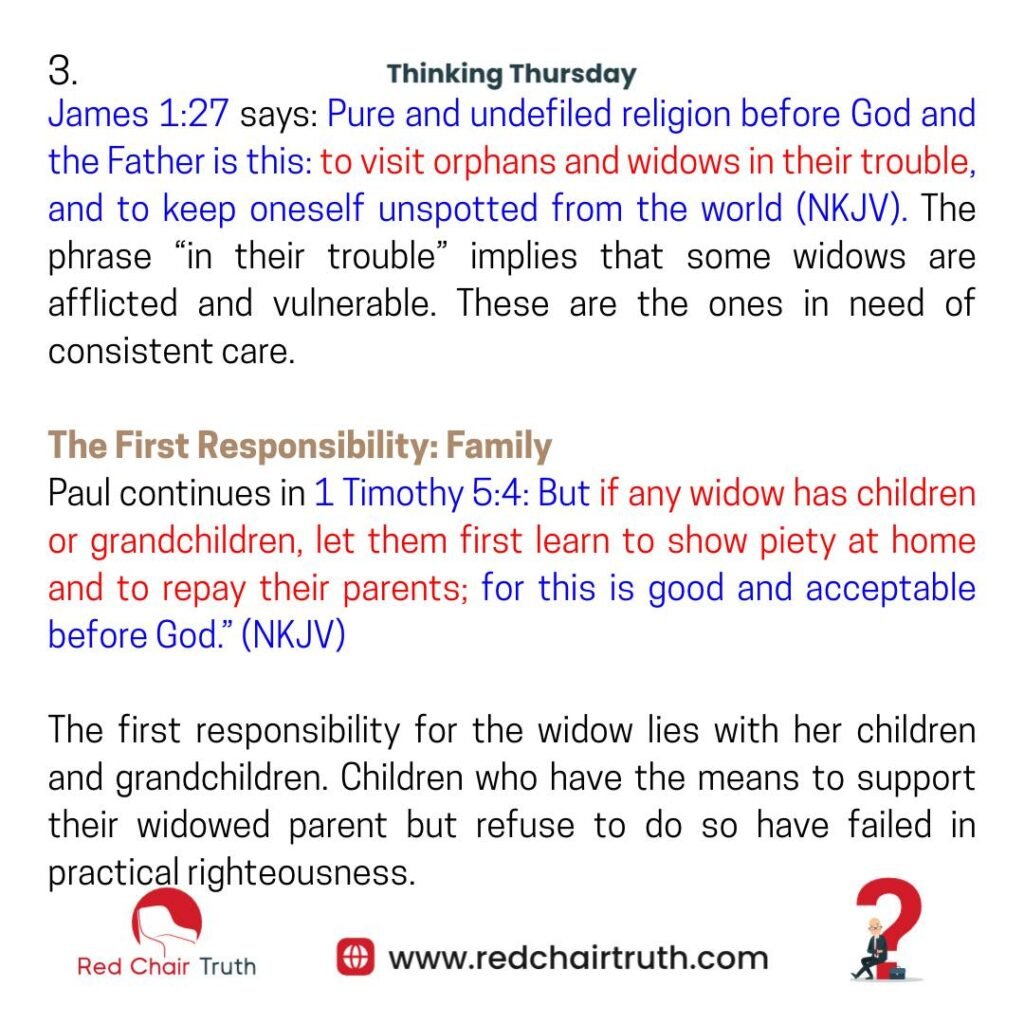
James 1:27 says: Pure and undefiled religion before God and the Father is this: to visit orphans and widows in their trouble, and to keep oneself unspotted from the world (NKJV). The phrase “in their trouble” implies that some widows are afflicted and vulnerable. These are the ones in need of consistent care.
READ ALSO: DOES THE CHURCH NEED A CHOIR? (PART 1)
The First Responsibility: Family
Paul continues in 1 Timothy 5:4: But if any widow has children or grandchildren, let them first learn to show piety at home and to repay their parents; for this is good and acceptable before God.” (NKJV)
The first responsibility for the widow lies with her children and grandchildren. Children who have the means to support their widowed parent but refuse to do so have failed in practical righteousness.
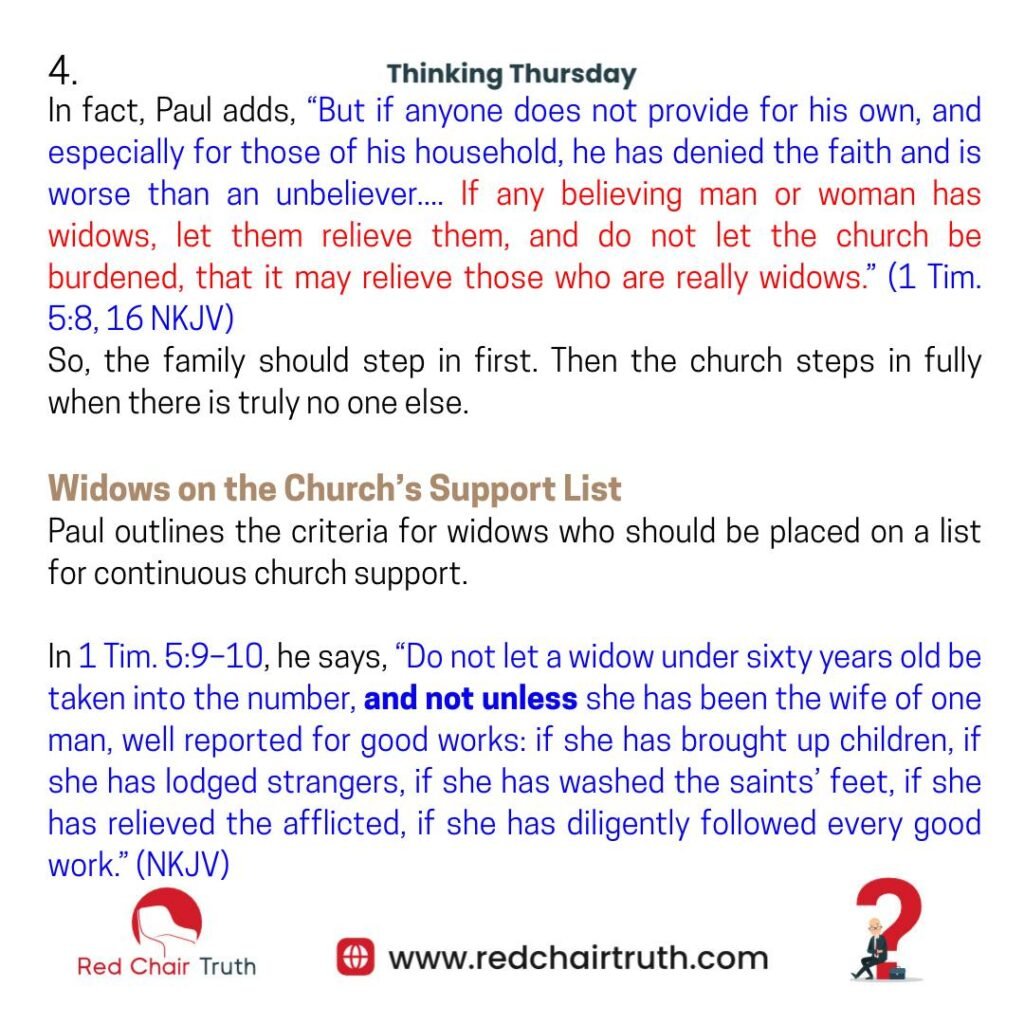
In fact, Paul adds, “But if anyone does not provide for his own, and especially for those of his household, he has denied the faith and is worse than an unbeliever…. If any believing man or woman has widows, let them relieve them, and do not let the church be burdened, that it may relieve those who are really widows.” (1 Tim. 5:8, 16 NKJV)
So, the family should step in first. Then the church steps in fully when there is truly no one else.
READ ALSO: BIBLE CONTRADICTIONS (PART 2)
Widows on the Church’s Support List
Paul outlines the criteria for widows who should be placed on a list for continuous church support.
In 1 Tim. 5:9–10, he says, “Do not let a widow under sixty years old be taken into the number, and not unless she has been the wife of one man, well reported for good works: if she has brought up children, if she has lodged strangers, if she has washed the saints’ feet, if she has relieved the afflicted, if she has diligently followed every good work.” (NKJV)
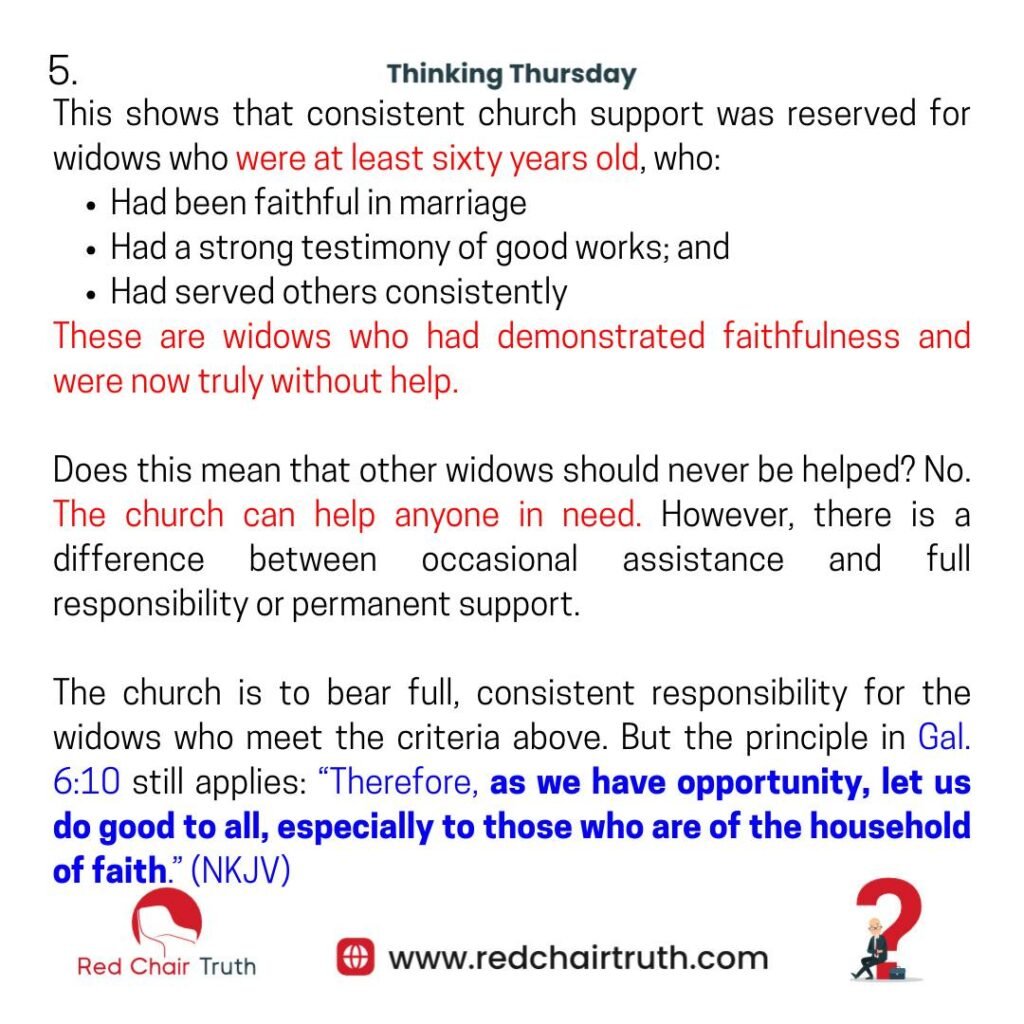
This shows that consistent church support was reserved for widows who were at least sixty years old, who:
- Had been faithful in marriage
- Had a strong testimony of good works; and
- Had served others consistently
These are widows who had demonstrated faithfulness and were now truly without help.
Does this mean that other widows should never be helped? No. The church can help anyone in need. However, there is a difference between occasional assistance and full responsibility or permanent support.
The church is to bear full, consistent responsibility for the widows who meet the criteria above. But the principle in Gal. 6:10 still applies: “Therefore, as we have opportunity, let us do good to all, especially to those who are of the household of faith.” (NKJV)
What About the Younger Widows?
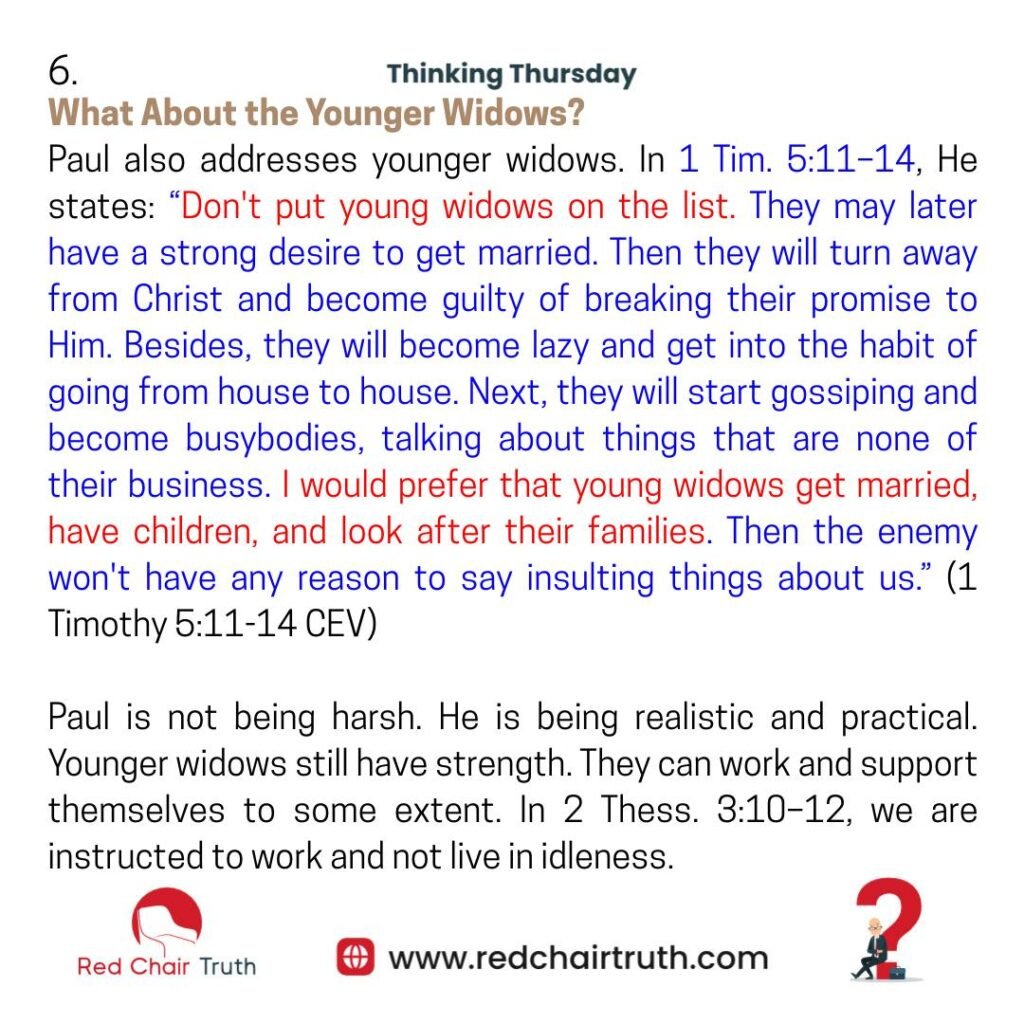
Paul also addresses younger widows. In 1 Tim. 5:11–14, He states: “Don’t put young widows on the list. They may later have a strong desire to get married. Then they will turn away from Christ and become guilty of breaking their promise to Him. Besides, they will become lazy and get into the habit of going from house to house. Next, they will start gossiping and become busybodies, talking about things that are none of their business. I would prefer that young widows get married, have children, and look after their families. Then the enemy won’t have any reason to say insulting things about us.” (1 Timothy 5:11-14 CEV)
Paul is not being harsh. He is being realistic and practical. Younger widows still have strength. They can work and support themselves to some extent. In 2 Thess. 3:10–12, we are instructed to work and not live in idleness.
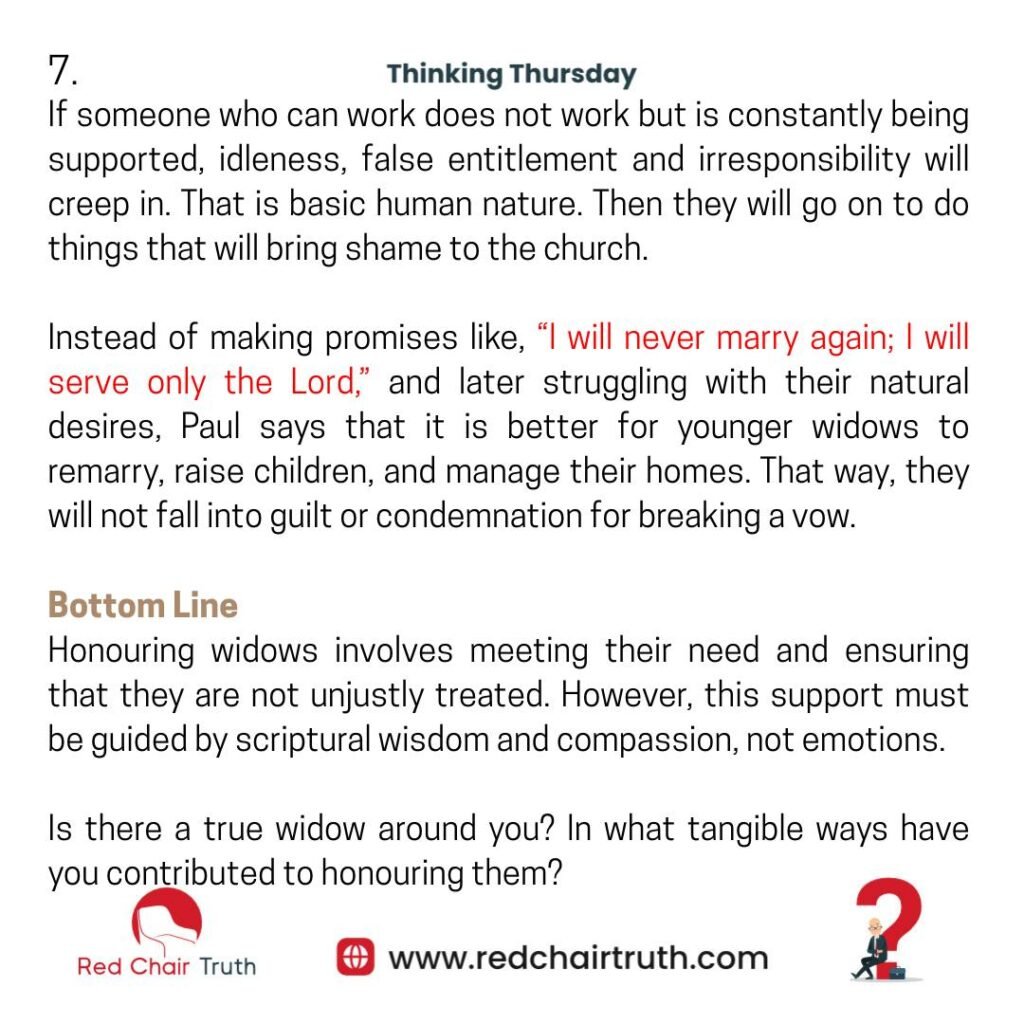
If someone who can work does not work but is constantly being supported, idleness, false entitlement and irresponsibility will creep in. That is basic human nature. Then they will go on to do things that will bring shame to the church.
Instead of making promises like, “I will never marry again; I will serve only the Lord,” and later struggling with their natural desires, Paul says that it is better for younger widows to remarry, raise children, and manage their homes. That way, they will not fall into guilt or condemnation for breaking a vow.
Bottom Line
Honouring widows involves meeting their need and ensuring that they are not unjustly treated. However, this support must be guided by scriptural wisdom and compassion, not emotions.
Is there a true widow around you? In what tangible ways have you contributed to honouring them?
READ NEXT: HONOUR (PART 24)